The Nottingham Forest European Cup story remains the most improbable in English football, and nearly half a century on it has not been dulled by repetition. Between May 1979 and May 1980, a club that had been playing Second Division football four years earlier won the biggest prize in the European game twice in a row. No English side has matched the speed of that ascent, and only a handful of clubs anywhere have retained the trophy.
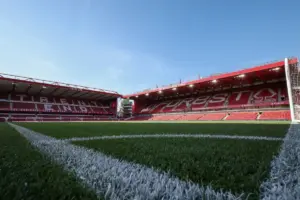
For newer supporters arriving at the City Ground in the Premier League era, here is the full story of how the Reds conquered Europe — the two finals, the route to each, and why those two stars above the badge still carry so much weight.
How Forest got there: promotion to champions in two seasons
Brian Clough took charge in January 1975 with Forest in the bottom half of the Second Division. Peter Taylor, his assistant from their Derby County years, joined him in the summer of 1976. Together they took Forest up in third place in 1976-77 — promoted on the final day without kicking a ball — and then, in their first season back in the top flight, won the First Division title in 1977-78 by seven points.
That title was the qualification. In the era before the Champions League group stage, only national champions entered the European Cup and it was a straight knockout from the first round. Forest went in as English champions and as complete unknowns to most of the continent.
1979: Trevor Francis and the header in Munich
The draw could hardly have been crueller. Forest’s first-round tie on their European Cup debut was against Liverpool — the reigning European champions, and the side Forest had just displaced domestically. Forest won 2-0 at the City Ground and held out for a goalless draw at Anfield to go through.
AEK Athens, Grasshoppers of Zurich and a semi-final against Köln followed. The German side came to the City Ground and drew 3-3, which left Forest needing to win in Cologne — a result almost nobody outside the dressing room expected. Ian Bowyer’s header settled it 1-0 and put Forest into the final.
The final was played at the Olympiastadion in Munich on 30 May 1979 against Malmö of Sweden. It was not a classic. The decisive moment came shortly before half-time: John Robertson, the left winger who was the heartbeat of that team, took the ball to the byline and crossed to the far post, where Trevor Francis arrived to head in.
Francis had joined from Birmingham City that February as Britain’s first £1m footballer, a fee Clough famously refused to dignify. He was cup-tied for the earlier rounds, so his first European appearance for Forest was the final itself — and he scored the only goal in it. Forest won 1-0 and were champions of Europe at the first attempt.
1980: Robertson’s turn in the Bernabéu
Holders entered the following season’s competition automatically, which was just as well — Forest had finished second in the league. The 1979-80 run took them past Öster of Sweden and Argeș Pitești of Romania, then to a quarter-final against Dynamo Berlin in which Forest lost the home leg 1-0 before winning 3-1 in East Germany. Ajax were beaten in the semi-final.
The final, on 28 May 1980 at the Santiago Bernabéu in Madrid, pitted Forest against Hamburger SV and Kevin Keegan, then a two-time European Footballer of the Year. Forest were widely expected to lose.
Roughly twenty minutes in, Robertson collected the ball, drove infield from the left — the reverse of everything a winger is supposed to do — and struck a low shot in off the far post. It was the only goal of the game. Peter Shilton and a defence marshalled by Kenny Burns and Larry Lloyd did the rest through a long second half of Hamburg pressure.
1-0 again. Two European Cups in two seasons, both won by a single goal, both won away from home.
What else that team won
- First Division title: 1977-78
- League Cup: 1978 and 1979, back-to-back
- European Cup: 1979 and 1980
- European Super Cup: 1979, beating Barcelona over two legs
Forest also reached the 1980 Super Cup final, losing to Valencia on away goals, and played Nacional of Uruguay for the Intercontinental Cup in Tokyo in February 1981, going down 1-0. And between November 1977 and December 1978 the side went 42 league games unbeaten — a top-flight record that stood until Arsenal’s Invincibles surpassed it in 2004.
Why the Nottingham Forest European Cup record is so unusual
Forest belong to a very small group of clubs who have won the European Cup more often than they have won their own domestic league. One league title, two European Cups. It is a ratio that says everything about how concentrated that period of success was — and how little came before or after it.
The squad was assembled cheaply and largely from the divisions below. Burns had been a forward at Birmingham and was converted into a centre-half who won the Football Writers’ Footballer of the Year award. Robertson was, in Clough’s own telling, an unremarkable figure off the pitch who became the most important player on it. Viv Anderson, a Nottingham lad who came through the club’s own ranks, became the first Black player to win a senior England cap.
The two stars above the badge
Those two stars are the reason the City Ground still feels different from a stadium of its size, and the reason the songs about the biggest cup in the world still go up on cold nights in West Bridgford. Forest have never returned to a European Cup final, and the competition itself has changed beyond recognition since — champions no longer need to be champions to enter it.
But for a club that was a Second Division outfit in 1975, back-to-back European titles by 1980 remains the sport’s great outlier. Every Forest supporter knows the two dates. Munich, then Madrid. 1-0, then 1-0.
More from the Reds’ record books: Nottingham Forest record signings — the 10 most expensive transfers in Reds history. The club’s full honours list is published on the official Nottingham Forest website, and the competition’s complete roll of honour is held by UEFA.