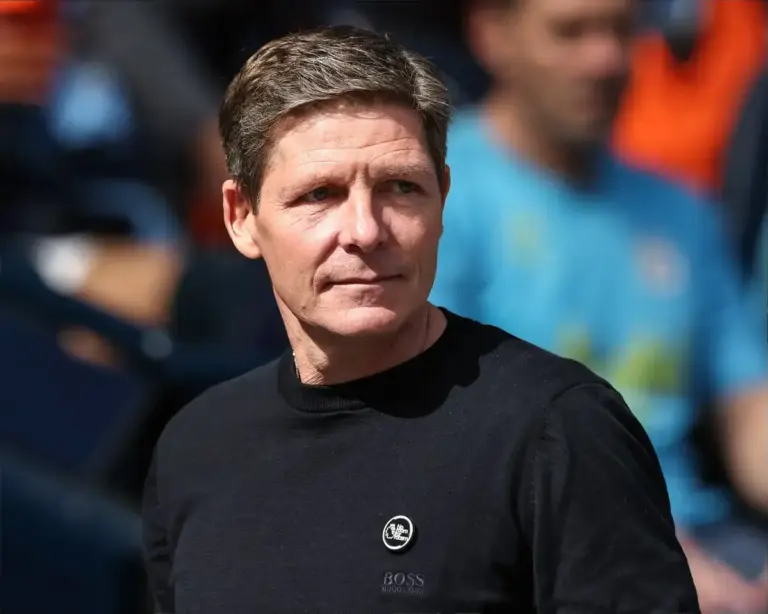
Oliver Glasner arrived at the City Ground in July 2026 with a CV that most Premier League clubs would happily pay a premium for: a European trophy, an FA Cup, a Community Shield and a reputation as one of the most distinctive tactical thinkers working in England. Yet for plenty of Nottingham Forest supporters, the Austrian is still a relatively unfamiliar figure. So who is Oliver Glasner, how did he get here, and what does he actually want his teams to do?
From SV Ried defender to the dugout
Glasner’s route into coaching was not the glamorous one. Born in Austria in August 1974, he spent almost his entire playing career as a centre-back at SV Ried, the modest Upper Austrian club where he made hundreds of appearances across two decades and won the Austrian Cup. He was a captain, a leader and a defender in the old-fashioned mould rather than a headline name.
His playing days ended abruptly in 2011 after he suffered bleeding on the brain following a clash of heads in a match — an injury that forced immediate retirement at 36. Ried kept him on as an assistant coach, and within a year he had been recruited by Red Bull Salzburg to work as assistant to Roger Schmidt. That spell is the one Glasner still credits for shaping his ideas about pressing, transitions and vertical football.
He returned to Ried as sporting director before taking the LASK job in 2015, and it was there that he made his name: promotion out of the Austrian second tier, then a rapid climb that turned LASK into genuine title challengers and European regulars. Wolfsburg came calling in 2019, and Glasner delivered a fourth-place Bundesliga finish and Champions League qualification in his second season.
Oliver Glasner’s trophies: Seville, Wembley and everything in between
The move that made Glasner a European name was Eintracht Frankfurt. In his first season, 2021/22, he took a mid-table German side on an unbeaten run through the Europa League that finished with victory over Rangers on penalties in the Seville final — and, with it, qualification for the Champions League. Frankfurt went on to reach the last 16 of that competition, and Glasner left in 2023 having comfortably over-delivered.
Crystal Palace, in February 2024, is where English football properly took notice. Glasner transformed a side flirting with relegation into one of the most watchable teams in the division, and in May 2025 he ended Palace’s long wait for a major trophy by beating Manchester City 1-0 in the FA Cup final at Wembley. Three months later, his Palace side beat Liverpool on penalties to win the Community Shield. Those two afternoons are, by some distance, the biggest days in Crystal Palace’s history — and they are a large part of why Forest moved so decisively for him this summer.
The 3-4-2-1: how Glasner sets his teams up
Almost everywhere he has worked, Glasner has settled on a back three and, more specifically, a 3-4-2-1. It is not a formation he treats as a preference so much as a framework: two wing-backs providing the entire width, a double pivot screening the defence, and two roaming No 10s operating in the pockets either side of a physical centre-forward.
The demands are unusual. Wing-backs must cover enormous ground; centre-backs are asked to defend big spaces one-on-one; and the front three are expected to press in a coordinated, aggressive shape designed to win the ball high and attack immediately. When it clicks, it produces the kind of fast, direct, front-foot football that made Palace such a difficult night out. When it does not, the gaps between the lines are obvious — which is part of what Forest have been wrestling with in the opening weeks of 2026/27. Our breakdown of how Glasner’s 3-4-2-1 works at Forest goes into the detail.
It also explains the club’s recruitment. Ousmane Diomande was signed as a ball-playing centre-back comfortable defending space; Xaver Schlager arrived on a free from RB Leipzig as a runner for the double pivot; and the club-record £45m capture of Liam Delap from Chelsea was, in Glasner’s own words, about a very specific profile.
“We were looking for a striker with physicality, and especially with pace and able to make runs in behind,” he explained, speaking to reporters including Nottinghamshire Live. “We have a top, top striker in the box with Chris Wood, who is a proven Premier League goalscorer. We have the more playing No.9 with Igor (Jesus). Liam is the perfect fit and I think we are the perfect club for him.”
What Oliver Glasner has said since arriving at Forest
Glasner has been consistent on one point since day one: this is a rebuild, and rebuilds take time. Forest spent last season fighting relegation, and the new head coach has repeatedly framed the psychological repair job as bigger than the tactical one.
“This is the biggest part, to be honest,” he said of the squad’s mentality, in comments reported by Nottinghamshire Live. “When you have such a difficult, challenging, tricky season then something happens in your head. It is not just talking about the legs and the tactics, it’s a lot of psychology and confidence. There is no button you can press.”
He has been equally blunt about the start to his reign, which brought back-to-back home defeats to Leeds United in the Premier League and the Carabao Cup. “We all thought because we had a really good pre-season that we are further than where we are, but Premier League football is bit different,” he admitted. “It was not the start we all wanted but that is life sometimes.”
The job at the City Ground
Glasner inherited a squad in the middle of significant change. Elliot Anderson’s £116m sale to Manchester City reshaped the midfield overnight, Taiwo Awoniyi joined Coventry City, and Ryan Yates was confirmed as captain in pre-season with Morgan Gibbs-White remaining the side’s creative heartbeat. Four signings arrived over the summer, and at least one more is expected before the window shuts.
The brief, in short, is to make Forest a settled, competitive Premier League side again rather than one that survives by the odd point — and, in time, to add to a trophy cabinet that still glitters with two European Cups. Glasner has done the improbable at Frankfurt and at Selhurst Park. Whether he can do it with the Tricky Trees is the question that will define Forest’s season.
Follow every twist across our Nottingham Forest coverage.