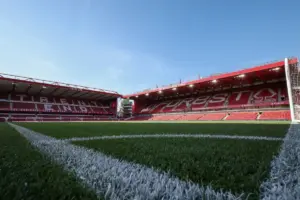
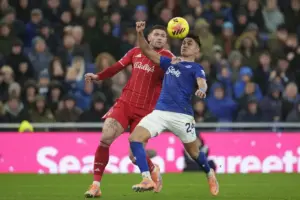
Stan Collymore spent two seasons at Nottingham Forest and left as the most expensive footballer Britain had ever produced. That is the whole story in one line, and it undersells it. Between the summer of 1993 and the summer of 1995 he dragged a relegated, post-Clough Forest side back into the top flight, then finished third in the Premier League with them, then walked out of the door for £8.5m — a fee that at the time nobody in this country had ever paid for anyone.
Thirty years on, in a week when the Reds have just banked a reported £116m for Elliot Anderson, the numbers look almost quaint. They were not quaint then. Here is how the two best years of Collymore’s career happened, and why supporters of a certain age still talk about them.
Before the City Ground: released, rebuilt, and scoring for fun
Collymore’s route to Forest was not the usual one. Born in Stone in January 1971 and raised in Cannock, he was let go by Walsall as a teenager and could not force his way through at Wolverhampton Wanderers either. He dropped into non-league with Stafford Rangers, which is where Crystal Palace found him in 1991.
Palace did not play him much. Southend United took him in late 1992 for a small fee and he immediately started scoring — enough goals in half a season at Roots Hall to convince a First Division club that he was worth a club-record punt.
The transfer: a club record, at exactly the wrong moment
The club was Forest, and the timing was brutal. The Reds had just finished bottom of the inaugural Premier League season and gone down. Brian Clough had retired after 18 years. The club’s identity was tied up almost entirely in one man, and that man had gone.
Frank Clark — a left-back in the side that won the European Cup in 1979 — came back to manage, and his first big decision was to spend a club-record fee, reported at around £2.25m, on a 22-year-old striker from Southend who had never played a full season in the top flight. It was a substantial gamble for a newly relegated club. It paid off faster than anyone expected.
1993-94: 19 league goals and a promotion
Collymore scored 19 league goals in his first season as Forest finished second in Division One and went straight back up at the first attempt. What the raw figure misses is the manner of them. He was 6ft 3in and quick, comfortable drifting to the left and coming inside, and he scored a genuinely absurd proportion of goals from outside the box for a centre-forward.
Clark’s Forest were also, pointedly, a passing side rather than a promotion-scrap side, which suited him. They went up playing football that supporters had half-worried would leave with Clough.
1994-95: third in the Premier League
The second season is the one that turned a very good striker into a British record transfer. Forest, freshly promoted, finished third in the Premier League — still the club’s highest finish in the competition — and qualified for the UEFA Cup. Collymore scored 22 league goals and was named in the PFA Team of the Year.
He had help. Bryan Roy, the Dutch international signed from Foggia, played off him brilliantly, and Ian Woan supplied from the left. But Collymore was the reason opposition managers set their teams up differently at the City Ground, and by the spring he had earned his first England call-up.
His Forest record across the two seasons: 41 league goals in 65 league games. Very few players in the club’s history have had a two-year run like it. Our rundown of Forest’s all-time leading scorers is dominated by men who stayed a decade; Collymore did his damage in 24 months.
The £8.5m exit
Liverpool paid a reported £8.5m in the summer of 1995 to take him to Anfield. It broke the British transfer record, and it made Collymore the answer to a pub-quiz question that lasted years. For Forest it was, on the day, extraordinary business: a player bought for £2.25m sold for nearly four times that inside two years.
What happened next is the part that still divides opinion. Forest reinvested — Kevin Campbell, Chris Bart-Williams, and the Italian forward Andrea Silenzi among them — and reached the UEFA Cup quarter-finals in 1995-96 before Bayern Munich ended the run. Then it unravelled. Forest were relegated in 1997. Collymore, meanwhile, never quite recaptured Nottingham at Anfield, despite scoring in one of the most famous Premier League matches ever played, and moved on to Aston Villa, Leicester City and Bradford City before retiring in 2001 at 30.
He has spent the years since as a broadcaster and columnist, and has spoken openly about the depression he was managing during his playing career — a conversation football was not remotely equipped to have in 1995.
Where the Stan Collymore fee sits now
This is where the passage of time does its work. Collymore’s fee stood as Forest’s record sale for a generation. It is now a long way down the list. Anderson’s move to Manchester City this summer was reported at around £116m, and even the club’s record purchase — Liam Delap from Chelsea, a fee the Nottingham Post puts at £45m — is five times what Liverpool paid for Collymore. The full list of the biggest fees Forest have received tells the story of how the market moved.
Adjusted for the inflation of the transfer market rather than the pound, though, the 1995 deal remains one of the largest sales in the club’s history. Forest sold a 24-year-old British-record striker and stayed in the Premier League for two more seasons on the proceeds.
How good was he, really?
Good enough that he rarely makes the all-time Forest teams and nobody thinks that is unfair — which tells you more about the club than about him. A Forest greatest XI has to find room for European Cup winners, and two years, however brilliant, struggles against a decade of John Robertson or Stuart Pearce.
But on pure output, Collymore’s 1993-95 is among the most productive spells any Forest forward has had. He arrived at a club that had lost its manager, its Premier League status and its sense of itself, and he scored it back up the table almost single-handedly. For a fanbase used to measuring everything against 1979 and 1980, that is no small thing.
You can read more about the era at the official Nottingham Forest website, and the full career record is catalogued on his Wikipedia entry.