Who owns Nottingham Forest? It is one of the most-asked questions about the Reds, and the short answer is Evangelos Marinakis – the Greek shipping magnate who bought the club in May 2017 and has overseen the most dramatic decade of change at the City Ground since the Brian Clough era. This is the full story of how Forest ended up in Greek hands, what else Marinakis owns, and why his shareholding is now structured the way it is.
Who owns Nottingham Forest? The short answer
Nottingham Forest are majority-owned by Evangelos Marinakis, a Piraeus-born businessman whose fortune comes from shipping. He completed his takeover of the club in May 2017 through the holding company NF Football Investments, buying out the Al-Hasawi family for an undisclosed fee. He has been the controlling figure at the City Ground ever since, and is the man whose money paid for the squad that took Forest back to the Premier League and, three years later, back into Europe.
Marinakis is not a boardroom absentee. He is a familiar figure on the pitch after big results, and Forest’s transfer strategy – aggressive, expensive and unafraid of a club-record fee – carries his fingerprints. The club’s record signings list has been rewritten several times over on his watch.
Before Marinakis: from members’ club to Kuwaiti ownership
For most of their history Forest did not have an owner at all. The Reds were run as a members’ club, governed by a committee rather than a single proprietor – one of the last of their kind in English football, and part of why the club always felt slightly out of step with the game’s money.
That changed in 1999, when the businessman Nigel Doughty took control and began funding the club through what turned out to be a long, grinding spell outside the top flight. Doughty stepped down in 2011 and died in February 2012. Later that year the Kuwaiti Al-Hasawi family bought the club, promising a swift return to the Premier League. Instead came managerial churn, a transfer embargo and a slide that ended with Forest surviving relegation to League One on the final day of the 2016-17 season – days before Marinakis arrived.
What else does Evangelos Marinakis own?
Forest are not his only football club. Marinakis has been the driving force at Olympiacos, the biggest club in Greece, since 2010, and added the Portuguese side Rio Ave in 2022. Away from football, his primary business is shipping: Capital Maritime & Trading Corp and associated companies operate one of the larger tanker fleets under Greek control. He has also held elected office as a city councillor in Piraeus and has interests in Greek media.
That multi-club portfolio is the reason Forest’s ownership paperwork looks more complicated than a simple “one man, one club” arrangement, and it matters for a very practical reason: UEFA.
The blind trust and UEFA’s multi-club rules
UEFA’s regulations are designed to stop two clubs controlled by the same person competing in the same European competition. When Forest finished seventh in 2024-25 and qualified for continental football for the first time since the 1995-96 campaign, that put them on a potential collision course with Olympiacos.
The widely reported solution was for Marinakis to place his Forest shareholding into a blind trust, removing his day-to-day decision-making control on paper so that both clubs could be cleared to compete. It is a mechanism several multi-club owners across Europe have used, and it does not change who ultimately benefits from owning the club – only who is deemed to be running it. The same set of rules has caused friction elsewhere in the Premier League, and Forest have been directly involved in the fallout.
What his ownership has actually delivered
The record is mixed but, on balance, transformative. Forest won promotion through the Championship play-offs in 2022, beating Huddersfield Town at Wembley to end a 23-year absence from the top division. Survival followed in 2023, then again in 2024 – that one achieved despite a four-point deduction for breaching the Premier League’s profitability and sustainability rules, a direct consequence of the enormous spending that got them up in the first place.
The high-water mark came in 2024-25, when a seventh-place finish delivered European football to the City Ground for the first time in a generation. Off the pitch, Marinakis’s ownership has also pushed forward long-stalled plans to redevelop the ground itself, with a draft agreement over the land around the stadium finally clearing one of the biggest obstacles to expansion.
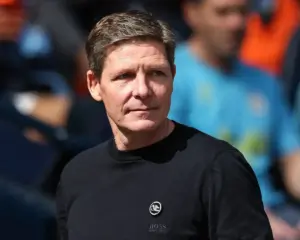
The cost has been volatility. Head coaches have come and gone at a rate that would unsettle most clubs – Oliver Glasner, appointed in July 2026, is only the latest to be handed the job with a brief to win now. Squad turnover has been just as brutal: more than 30 players arrived in the first two windows after promotion, and the churn has barely slowed since.
Is Nottingham Forest for sale?
There is no indication that Marinakis is looking to sell. He has repeatedly committed to the club publicly, the stadium project points to long-term planning rather than an exit, and Forest’s rising valuation since 2017 gives him little reason to move on. As with any privately held club, minority investment is always possible – but the controlling interest, held through the trust structure, remains his.
The bottom line
So, who owns Nottingham Forest? Evangelos Marinakis – a Greek shipping magnate with a portfolio of clubs, a formal blind-trust arrangement to satisfy UEFA, and a decade-long record at the City Ground that has taken the Reds from the brink of League One to European football. Supporters who remember the lean years under committee rule and absentee owners will tell you the trade-off – instability in exchange for ambition – has been worth it. The club’s trophy cabinet still belongs to another era, but for the first time in a long time, Forest are spending like a club that wants to add to it.
Sources: Nottingham Forest official website, Premier League and Nottinghamshire Live.