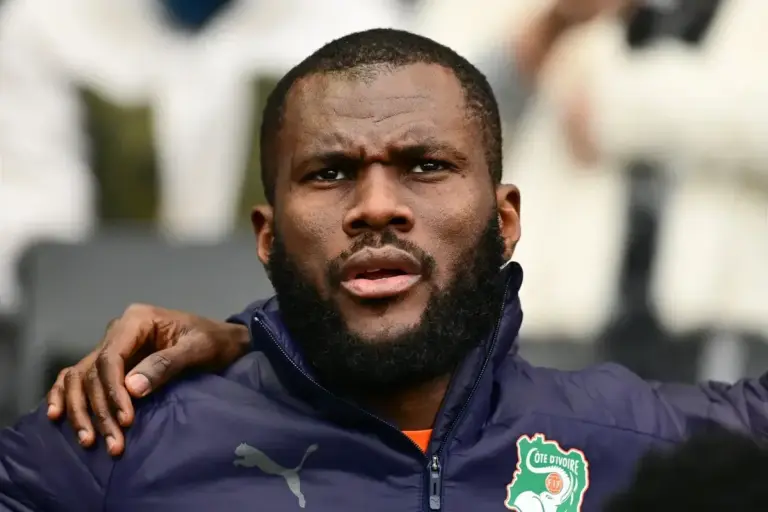
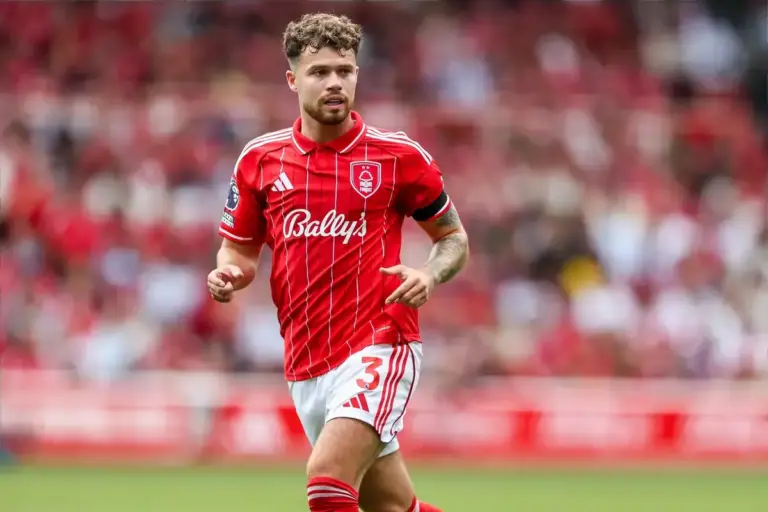
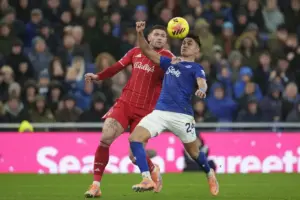
The Ibrahim Sangare Nottingham Forest story is one of the more complicated of the Marinakis era. He arrived on the banks of the Trent as a reported £30 million signing, one of the biggest fees the Reds had ever paid for a midfielder, and he has spent the time since being alternately indispensable, injured and out on loan. Now, under Oliver Glasner, the No.6 finds himself in a Forest midfield that is short on numbers and badly in need of exactly what he does well.
Here is everything Reds supporters need to know about the Ivory Coast international wearing No.6 at the City Ground.
Who is Ibrahim Sangaré?
Sangaré is an Ivorian central midfielder, born in Daloa on 2 December 1997. At 6ft 4in he is one of the tallest central midfielders in the Premier League, and that physical profile has defined both how he plays and how he is used.
He made his name in France with Toulouse, breaking into the first team as a teenager and playing well over a hundred Ligue 1 games for a club that was regularly fighting near the bottom of the table. That is a demanding apprenticeship for a young midfielder – plenty of defending, plenty of running, very little comfort – and it built the side of his game that Forest supporters recognise most readily.
In 2020 he moved to the Netherlands with PSV Eindhoven, and it was there that his reputation grew properly. Three seasons in Eindhoven brought domestic cup success, European football and a steady stream of scouts from bigger leagues. By the summer of 2023 he was one of the most sought-after defensive midfielders outside the continent’s wealthiest clubs, with Forest eventually winning the race.
The move to the City Ground
Forest completed the deal in September 2023 for a reported £30m, structured as a loan with an obligation to buy – a mechanism the club used more than once in that period. It made him, at the time, one of the most expensive players in Forest’s history, and it came with a level of expectation that has not always been easy to carry.
His Forest career has been genuinely uneven. There have been spells where he has looked exactly like the player PSV sold: a screen in front of the back line who eats up ground, wins the ball cleanly and lets the more creative players get on with it. There have been others where rhythm has deserted him, and where injuries have interrupted him just as he was building momentum. He spent the second half of the 2024/25 season on loan at Burnley, who won promotion back to the Premier League, before returning to the City Ground.
Internationally, he has been a fixture for Ivory Coast for the best part of a decade and was part of the squad that won the Africa Cup of Nations on home soil in early 2024 – a reminder that, whatever the debate about his club form, he is trusted at the top level of the international game.
What kind of midfielder is he?
Sangaré is a destroyer far more than a conductor. His best work is done in the middle third: stepping across to intercept, using his enormous stride to cover for a wing-back who has pushed on, and winning aerial duels in a position where most teams are short of height. Set pieces at both ends benefit from having him on the pitch.
What he is not is a deep-lying playmaker who will drop between the centre-backs and dictate the tempo of a match for 90 minutes. He is a tidy, sensible passer rather than a progressive one, and Forest’s ball progression from deep has generally come from elsewhere. That distinction matters, because it explains why the Reds have spent so much of the past year chasing a different profile of midfielder – the pursuit of Corinthians’ Andre, which has now rolled over into January transfer talks, is about adding a controller alongside him rather than replacing him.
Ibrahim Sangare Nottingham Forest: how he fits Glasner’s system
Glasner’s 3-4-2-1 asks an unusual amount of its two central midfielders. With the wing-backs pushed high and two No.10s operating in front of them, the pair in the middle have to protect the width of the pitch, screen a back three and shuttle sideways for long stretches without the ball. Height, reach and ground coverage are not luxuries in that job. They are the job.
That is why Sangaré still matters here. The engine room is not deep: he lines up alongside Nicolás Domínguez, summer free-transfer arrival Xaver Schlager, captain Ryan Yates and James McAtee, with Morgan Gibbs-White operating ahead of them as the creative hub. Five senior central options for a 38-game season is workable rather than abundant, and the sale of Elliot Anderson to Manchester City for a club-record £116m removed the most dynamic ball-winner of the group in a single transaction.
Forest spent roughly £101m across the summer on five first-team signings, but none of them was the front-foot midfield destroyer who could turn Sangaré into a squad player. His place in the side is there to be taken, and it is his to lose on performance rather than on numbers.
What to expect this season
Fitness remains the obvious caveat. Sangaré missed the trip to Anfield with a minor calf problem picked up in training, then was not risked for the goalless draw with Tottenham Hotspur at the City Ground, with Glasner framing that as caution at the start of a season rather than a setback. “Everybody aside from Savona would have been available, but it just makes no sense risking anything at the beginning of the season,” the head coach explained afterwards.
Forest have taken two points from their opening three Premier League games – an opening-day home defeat by Leeds United, then draws away at Liverpool and at home to Spurs – and travel to Aston Villa on Saturday still chasing a first win of 2026/27. The pattern has been solid enough without the ball and short of ideas in front of goal.
In that kind of season, a fit Sangaré is worth more than his highlights reel suggests. If the Reds are going to grind results out of Villa Park and the run of fixtures that follows, they will do it by being difficult to play through in the middle of the pitch. That has always been his best argument, and at 28 it is still the one that keeps him in an Premier League starting eleven. The Tricky Trees paid a lot of money for a player who was never going to be spectacular. What they need from him now is simply to be available.